Angela Moorad, MS, CCC-SLP. Over 36 years experience in AAC. OMazing Kids AAC and app consulting. Creator of several AAC Feature Matching resources (https://omazingkidsllc.com/omazing-kids-aac-resource-links/). Includes info about unique features to support Gestalt Language Processors
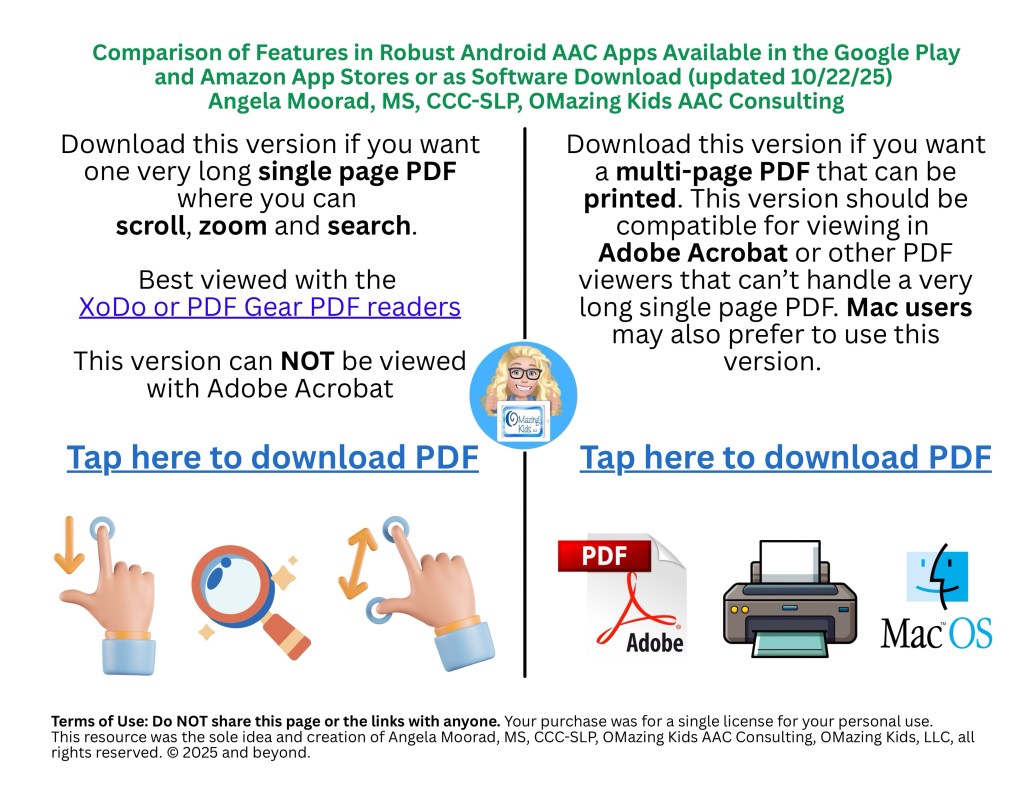
Added a new Landing Page to help folks choose which version of this resource you need (a single long page PDF where you can scroll, zoom and search OR a multipage PDF for those who want to print, view it in Adobe Acrobat or on a Mac computer)
Looking for other in-depth AAC feature matching resources? See this blog post: https://bit.ly/5aacFeatureMatchingResources. That post also includes videos comparing the best AAC apps on various devices on various platforms.
I was honored to be invited to make a guest post about my work.
I am not going to be talking about apps or devices or symbol sets.
I am going to talk about meeting a person with a communication disability. Perhaps a person who has a severe or profound intellectual disability, or perhaps they don’t.
The first question in my mind is “How do I need to be in order to be with you?” This might include where I sit, the speed and complexity of speech or not using speech, the amount of eye gaze, use of touch, degree of directness in interaction or referring more to the things around us. I observe what is responded to and what is not. I adjust what I do with an open mind to the needs for accommodations. I look for the sweet spot in which there seems to be some shared meaning, perhaps indicated in a lingered gaze, a leaning in, a responsive initiation directing the next step in our engagement.
Everyone I meet communicates expressively and receptively – and this is no exception for people with severe or profound intellectual and multiple disabilities. This might be their ALTERNATIVE communication to speech. They might communicate with symbols or without symbols. I explore how to fit myself to their receptive abilities and promote their expressions in each moment of engagement.
I consider things from the NOW and NEXT lens.
How are they communicating today, and how do I fit into that present way of communicating? For some people, communicating with them in a way that meets their current communication needs is lacking. For the person who engages best through touch, eye gaze, and a person sitting in physical contact to feel their changes in muscle tone with pleasure or displeasure, too often they are surrounded by partners relying solely on using speech towards them that they may not hear or process.
The first principle of my work is to guide interactions towards meeting current communication needs. This is no easy task when people may require highly individualised forms of communication and a cultural shift around them. Sadly much research has indicated that proffered interactions can be few and far between in group homes, can be unattuned to individual communication levels, and can ask partners to interact in a new way.
Much of my work is seeing when interaction does work and promoting this. A staff member sitting on the floor is recognised as attunement. A staff member repeating back the sounds of a person is seen as having a conversation without words that enables reciprocity. Seeing someone actively interpreting the movements of someone towards them is celebrated as valued social engagement – much like the relational doses discussed by Bruce Perry in the Neurosequential Model of Therapeutics.
Getting NOW communication right can be the entire focus of communication supports. Often latent (skills always there but rarely showed) communication skills and sometimes new skills may arise through better attuned interaction.
This dynamic, moment to moment engagement involves far more than what might be written in a gesture/symbol dictionary or communication profile. Often the dynamics of sustained engagement are best captured through video recordings and rich discussions of the possibilities inherent in real engagement.
Sometimes NEXT communication skills might be worked on. But these are never worked on in isolation to the NOW communication skills. A firm foundation or shared meaning using what the person can do now is needed to build new skills.
For some people learning new skills is difficult and for some even maintaining present skills can be a challenge. It is perhaps analogous to a first and second language. For some people, their first language might be body language, facial expression, and sounds. Perhaps we aim to teach them a second language of pictures for communication. If we only speak to them using a second language that they have not mastered, there might be an absence of shared meaning. However if we maintain the use of their first language (albeit not a symbolic language), we maintain some form of shared meaning – such as a delight or interest expression – fundamental indications that the person is being noticed, witnessed, worthy of sincere attention and sharing of experiences.
“How do I need to be in order to be with you NOW and possibly NEXT?” is my starting point with each individual.
Want to learn more?
Join the “HOP: Hanging Out Program” Facebook group – a group focusing on people with severe or profound intellectual disabilities, bringing together research, good practice, and ethical considerations: https://www.facebook.com/groups/hangingoutprogram
Note from Angela: I invited Sheridan to do this guest blog post during AAC Awareness Month to help boost the signal of her very important work. I enjoy the deep perspectives and resources that she shares in her Facebook group and I admire her willingness to speak up when online discussions in other groups become too narrowly focused on symbolic communication and high tech AAC.
11/1/25: A must read related post by N of 1 on Facebook:
If you are looking for an AAC option that will reliably and easily include videos and music files stored on that iPad that have been linked to play on a button then GoTalk Now is a tool that you should consider adding to your AAC toolkit.
When you export a Communication Book from GoTalk Now (or GoTalk Now Plus) using the “Share Compressed Book” option it fully embeds and includes all videos, music files, recorded audio, photos, etc.. and reliably includes those when backing up and sharing.
That’s why I recommend GoTalk Now (or GoTalk Now Plus) as a supplemental tool in the AAC toolbox for those who will be using lots of video clips or music.
Note: The free GoTalk Now Lite and inexpensive GoTalk Start versions of this app do not have a way to backup or share.
Feel free to join my GoTalk Now AAC & GoVisual Visual Scene Apps – Ideas and Sharing Facebook Group:https://bit.ly/GoTalkNowAACappGroup. There are now two staff from Attainment Company, Inc. in the group.
Be sure to answer the questions when requesting to join and if you invite folks to join be sure they answer the questions. That’s how I keep the group secure from spammers.
Looking for in-depth AAC feature matching resources? See this blog post: https://bit.ly/5aacFeatureMatchingResources. That post also includes videos comparing the best AAC apps on various devices on various platforms.
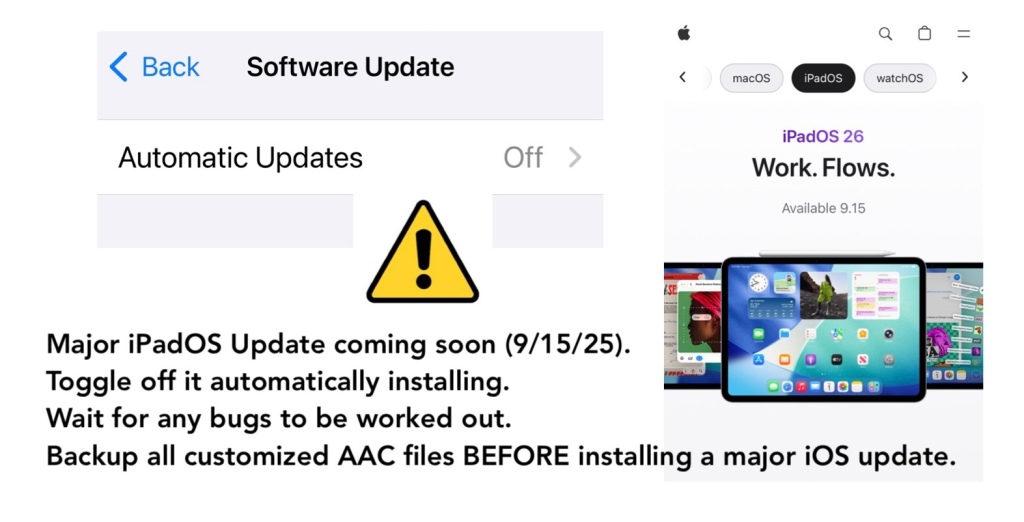
Major iPadOS / iOS update coming soon. Apple announced it will release iPadOS 26 & iOS 26 on September 15, 2025.
Tips for those using an iPad or iPhone for AAC:
⚙️ Toggle off it automatically installing iOS updates in the device Settings.
⏳ Wait for any bugs to be worked out. There are always things that Apple and App Developers need to fix especially after major iOS updates.
⚠️ Backup all customized AAC files BEFORE installing a major iOS update.
If your device is on a MDM device management system then you may not have control over it updating but you should still have a way to backup your customized AAC vocabulary files / grid sets / page sets / board sets to safeguard them and to have a way to restore them if needed.
Looking for in-depth AAC feature matching resources? See this blog post: https://bit.ly/5aacFeatureMatchingResources. That post also includes videos comparing the best AAC apps on various devices on various platforms.
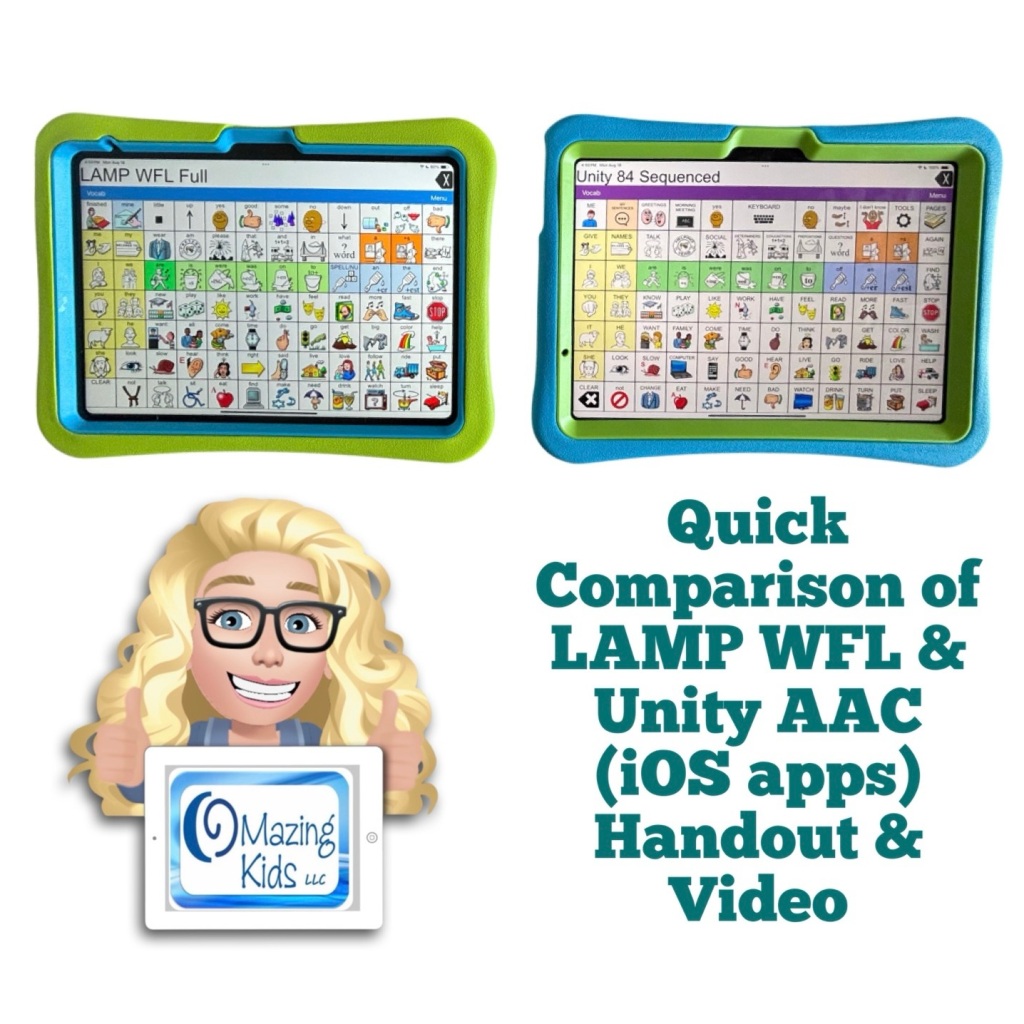
Want a quick way to compare some of the main differences between the new Unity AAC iOS app & the LAMP Words for Life iOS app?
✅ Check out my brand new resource “Quick Comparison of LAMP Words for Life & Unity AAC iOS Apps”
🎯 This resource includes a two page PDF handout with 23 rows comparing key differences between the LAMP Words for Life & Unity AAC iOS apps + exclusive access to an 49:29unlisted YouTube video where I show the differences. It is designed for a quick comparison (not an in-depth look at all of the features).
Created 8/19/25. This just highlights a few differences between these two iOS apps (not all of the features).
In-depth info about LAMP WFL features can be found in the Feature Matching Chart for the Top 13+ Robust iOS Symbol-Based AAC Apps: https://bit.ly/SymbolBasedAACapps
I’ll add info about the new iOS Unity AAC app to that soon.
Neither app is “better” than the other. It depends on the needs of the AAC user, their family and others supporting AAC use. Additional features may be available if using either software on PRC-Saltillo SGDs. Contact your local PRC-Saltillo Consultant for info about options on their SGDs.
Looking for in-depth AAC feature matching resources? See this blog post: https://bit.ly/5aacFeatureMatchingResources. That post also includes videos comparing the best AAC apps on various devices on various platforms.
Professionals need access in order to take AAC on a “test drive”. This new FREE handout includes info about how SLPs / SLTs and other AAC professionals can get access to over 25 robust and unique AAC apps or software for iOS, Android, Amazon Fire and Windows.
There is no “one size fits all” to anything about AAC and many individuals will need to use a variety of options (non tech, mid tech, high tech (SGDs, apps on an iPad or iPhone or other tablet or phone), sign language, gestures, facial expressions, vocalizations, segments of videos for gestalts, handwriting, etc…) as part of a multimodal system to support communication across environments and situations.
An AAC app is often part of a successful multimodal AAC system. While there isn’t any “perfect” AAC app there are features in these apps that might make some a better “fit” over other options.
It’s similar to taking a test drive to find a form of transportation that you like and meets your needs at that point in your life. All cars have an engine, tires and seats. Your first car may have been very basic transportation. But think about your dream vehicle. What features would it have? Why would you choose it over a different option? Older individuals might prioritize safety features. A teen or single young adult might prioritize the “look” / how “cool” it is. A family with young children might prioritize how many car seats can fit and storage. Others might prioritize fuel efficiency and eco-friendliness. You might ride a bike, subway, train, take an Uber ride, take a ferry, paddle in a canoe, etc. None of these is necessarily “better” than another or the “best” form of transportation. The “best” option is the one that meets the needs of that individual in that situation.
Looking for in-depth AAC feature matching resources? See this blog post: https://bit.ly/5aacFeatureMatchingResources. That post also includes videos comparing the best AAC apps on various devices on various platforms.
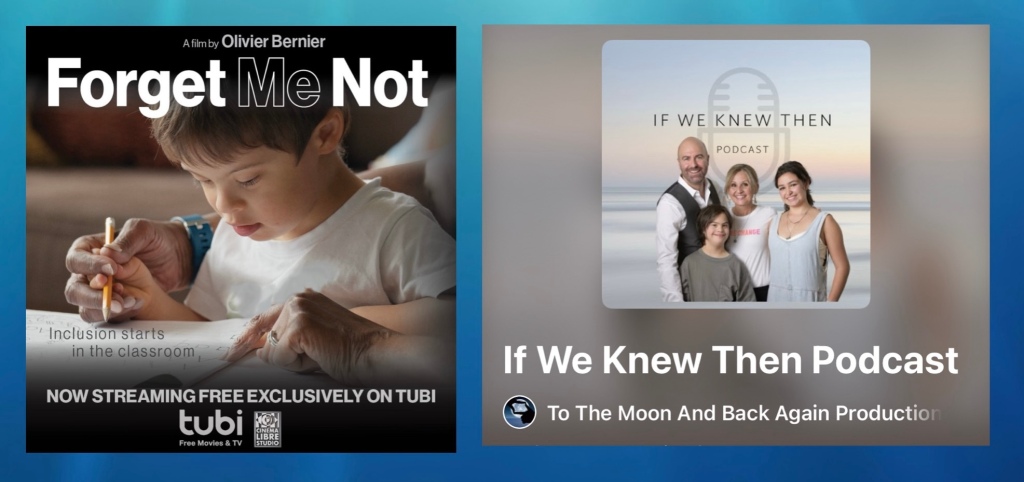
I encourage EVERYONE to watch the Forget Me Not: Inclusion in the Classroom documentary and then watch or listen to episodes 179 & 181 of the If We Knew Then podcast.
Everyone deserves the right to an equal opportunity for education.
The type of segregation and discrimination seen in the documentary and discussed in the podcast must end.
Parents should not have to endure this type of trauma from educational systems.
There needs to be proper supports in place for inclusion.
If you are a parent in the state of Oklahoma in the USA and need help from a parent advocate regarding your child’s IFSP or IEP, reach out to the Oklahoma Parents Center:https://oklahomaparentscenter.org
(Disclaimer: I am not a parent advocate and cannot advise anyone regarding their individual child’s IFSP or IEP. I am providing information in this blog post to help folks seek out help from entities equipped to do that)
Looking for in-depth AAC feature matching resources? See this blog post: https://bit.ly/5aacFeatureMatchingResources. That post also includes videos comparing AAC apps on various devices on various platforms.
How well does the App Developer communicate to let users know about known problems and what they are doing to resolve them?
How quickly are the issues resolved?
No app or software is immune from bugs regardless the size of the company or how long they have been around. The important part is how the app developer handles these issues, transparent communication, and how severely users are impacted.
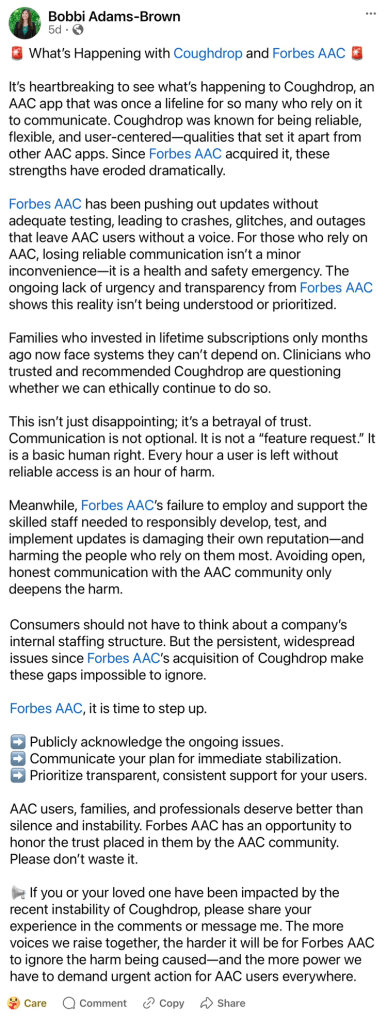
I have previously announced that I will be removing CoughDrop from my AAC feature matching resources due to increasing glitchiness over the years since Forbes AAC acquired the app in early 2023.
Unfortunately Forbes AAC has not been trustworthy or reliable and have made several promises to fix the app but then failed to deliver what was promised.
A recent update for the iOS version made things WORSE (not better). The second recent update for the iOS version improved a few things but not everything. I emailed the new CoughDrop Product Manager a screen recording video of ongoing issues related to the Premium Voices and iOS System Voices and differences between what’s available when using the app on my iPad vs. my iPhone.
I haven’t been able to install a Premium Voice in this app on my new Android tablet since part of the menu is cut off on the screen.
Forbes / CoughDrop has done a poor job of responding to user questions in their CoughDrop Users Group on Facebook. Hopefully this will improve with the new CoughDrop Product Manager joining the group. They need to provide ongoing engagement and support in this group to rebuild trust.
I truly hope the most recent promise by Forbes AAC will be fulfilled and CoughDrop can become a reliable AAC app again.
It will take a at least a year of Forbes maintaining and improving CoughDrop to earn trust as an app developer. For the sake of their users I hope this happens.
It’s an honor to have my OMazing Kids AAC Consulting blog and resource links page selected as the knAAC Awards “AAC Community Site of the Year” again in 2025: https://www.openaac.org/knaac-awards/2025/
Looking for in-depth AAC feature matching resources? See this blog post: https://bit.ly/5aacFeatureMatchingResources. That post also includes videos comparing the best AAC apps on various devices on various platforms.
Looking for in-depth AAC feature matching resources? See this blog post: https://bit.ly/5aacFeatureMatchingResources. That post also includes videos comparing the best AAC apps on various devices on various platforms.
* Updated with info about new features in apps, updated pricing info and updated lists of free apps.
Those who have previously purchased it on TPT can download the most current version for no additional cost: https://bit.ly/AAC-At-a-Glance.
Looking for in-depth AAC feature matching resources? See this blog post: https://bit.ly/5aacFeatureMatchingResources. That post also includes videos comparing the best AAC apps on various devices on various platforms.