Angela Moorad, MS, CCC-SLP. Over 36 years experience in AAC. OMazing Kids AAC and app consulting. Creator of several AAC Feature Matching resources (https://omazingkidsllc.com/omazing-kids-aac-resource-links/). Includes info about unique features to support Gestalt Language Processors
I had several older kids, teens and young adults that preferred the portability and the “look” of pocket-sized AAC. There are several iOS AAC apps that can be used on an iPhone or iPod Touch.And Android AAC apps that can be used on an Android phone. This allows it to fit in a pocket. Some used it as an alternative to their larger device. Others used it as their primary AAC. A few used wrist sized AAC on an Apple Watch.
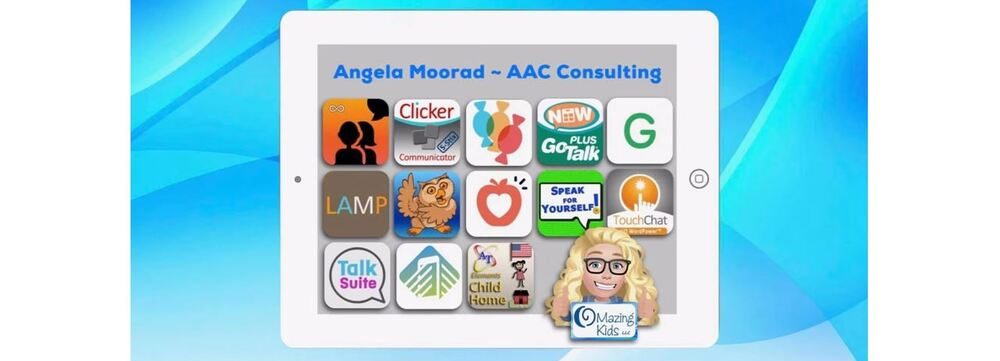
Here are the iOS AAC apps that can work on these smaller devices that I’ve found the most helpful. Each of these has unique features and vary in how robust they are. Some of the features may be slightly different than those seen on an iPad or iPad Mini.
Symbol-based apps for iPhone & iPod Touch:
* Avaz (also available for Android)
* Bridge Communication
* Cboard (also available for Android)
* ChatterBoards
* CoreVoice (also available for Android)
* CoughDrop (also available for Android)
* LAMP Words for Life
* Proloquo + Proloquo Coach
* Proloquo2go (can also be used in a limited way on an Apple Watch)
* Speak for Yourself
* Touchchat with WordPower
* Unity AAC
* Weave Chat AAC (also available for Android)
Text-based apps for iPhone & iPod Touch:
* ClaroCom Pro
* Dialogue AAC
* Flip Writer AAC Pocket
* Predictable (also available for Android)
* Proloquo4Text (can also be used in a limited way on an Apple Watch)
* SayIt (no longer available)
* Speech Assistant AAC (can also be used on an Apple Watch. They have a separate app available for Android)
* Spoken (also available for Android)
* Talk Assist
* Talk for Me
* Talkie (also available for Android)
* Type and Speak
* TypingTalk AAC (also available for Android)
* QuickType (no longer available)
* Vocable (also available for Android but with fewer features)
* Weave Chat AAC (also available for Android)
There are several other text-based AAC apps for Android devices. See the Basic Feature Chart for Affordable and Free AAC apps & AAC-Related Apps linked below.
The keyboard area in a symbol-based AAC app could also be used and some of those apps have a way to toggle off symbols to create a text only set up.
Updated 1/19/24: A great free option on an iPhone or Apple Watch is Live Speech (iPhone XS or later on iOS 17 or later, Apple Watch Series 3 or later on watchOS 10, or later. Accessibility – Speech): https://support.apple.com/en-us/105018. On an iPhone you can set it to open immediately via a double tap under Back Tap (https://support.apple.com/en-us/111772). This allows you to have immediate access to typing and a few saved phrases even on the Lock Screen.
There are lots of other specialty AAC apps than can be used on an iPhone or iPod Touch. Many are designed for use in medical situations or can be helpful for very specific situations. See this post on for screenshots of how I have them organized in folders on my iPhone: https://www.facebook.com/174264525957894/posts/3917269238324052/?d=n.
This resource contains a 6 page PDF handout + exclusive access to 3 unlisted YouTube videos with easy to understand information. Basic info about features of 33 apps and features available for the Apple Watch (8 apps and a feature specifically designed for AAC + 25 AAC-related apps and features that can be used to communicate in a variety of creative ways… including some that allow you to play short video and audio clips with sound playing directly on the speaker of the Apple Watch)
You may need to consider connecting the Apple Watch to a wearable Bluetooth speaker to amplify the sound. See this blog post for info about the Noxgear 39g and other wearable Bluetooth speakers: https://bit.ly/CanYouHearMyAAC
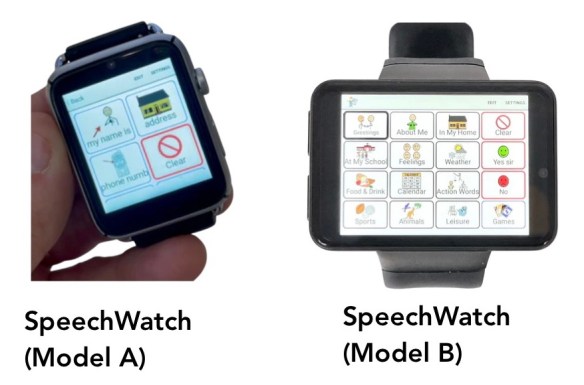
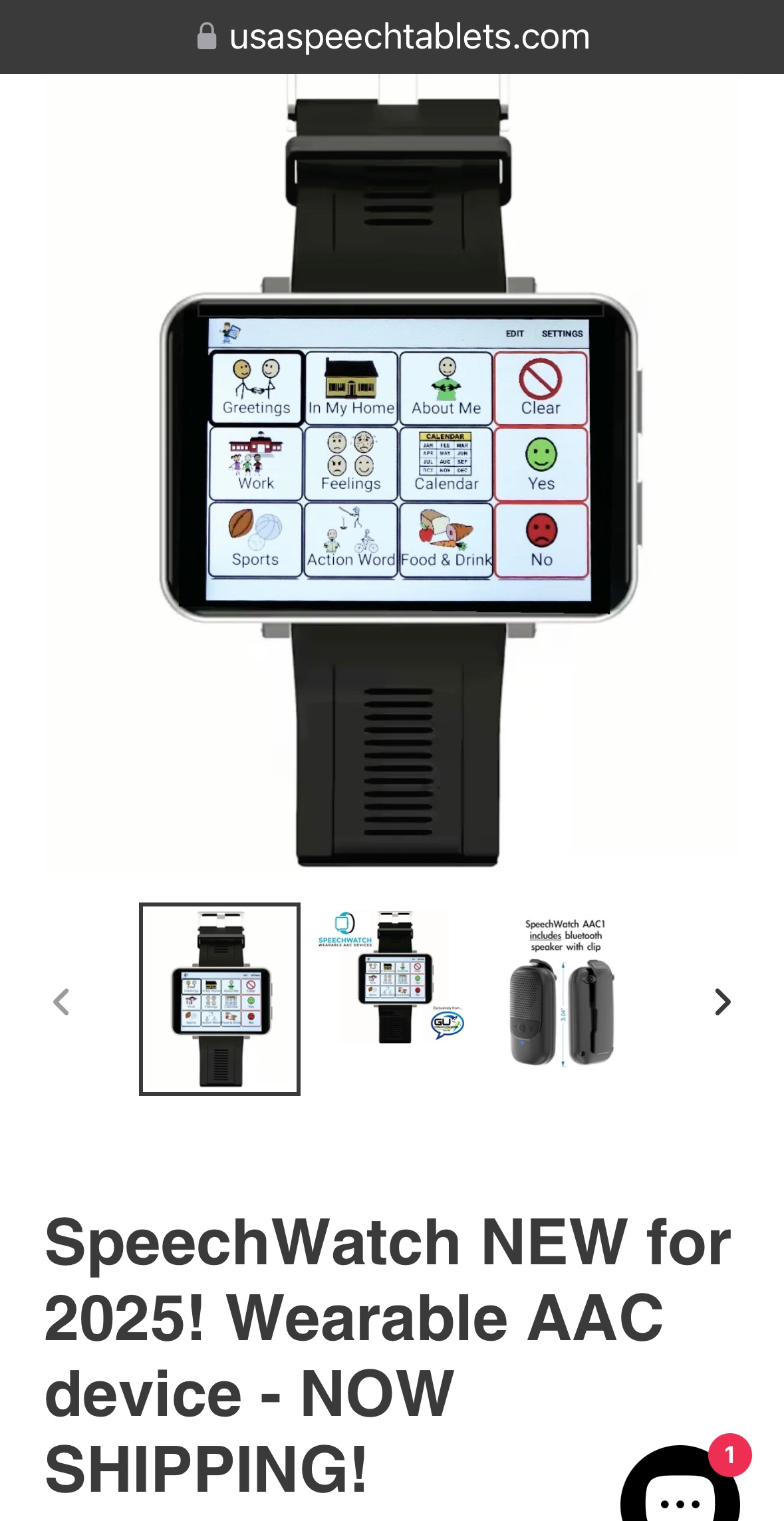
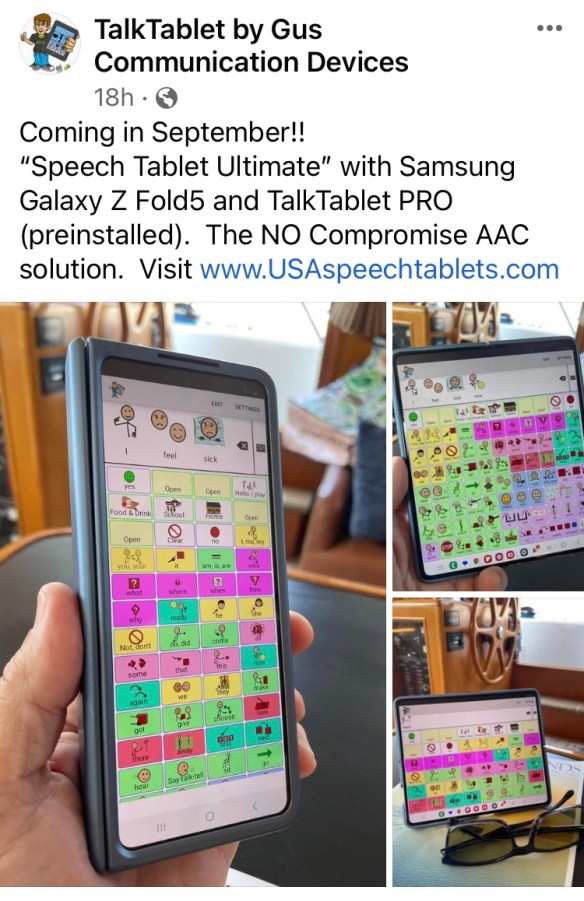
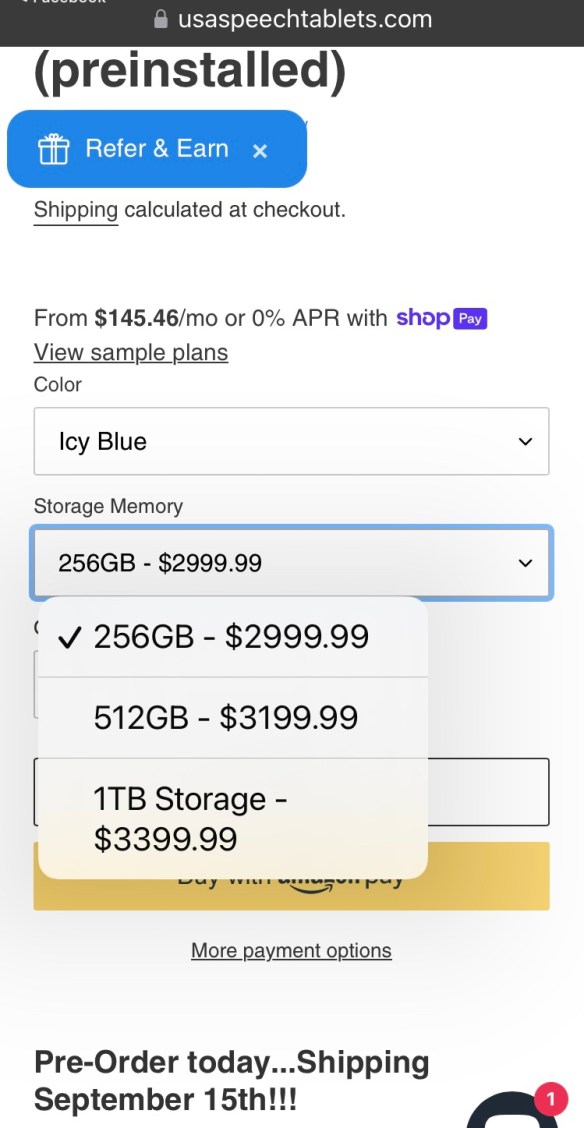
SpeechWatch with TalkTablet Pro: I don’t typically recommend the TalkTablet app since it’s not very intuitive to use but wanted to include their watches in this post for those who might watch to research them further. I have no idea how well these work and am not sure what type of watch was used to build them (it’s not an Apple Watch): https://usaspeechtablets.com/products/swa & a much larger one: https://usaspeechtablets.com/products/swb
Updated 4/6/25: That item is no longer shown on their website
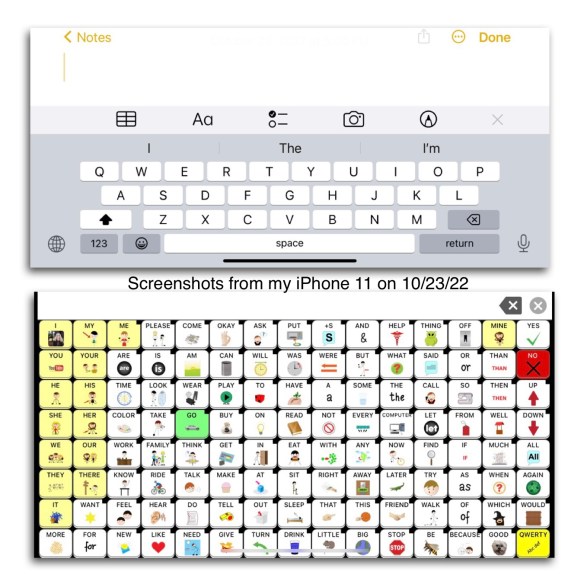
Updated 10/23/22:
There is a need for more AAC apps to beusable on an iPhone & Android phone. I get numerous requests every month for info about the options. Sadly more than half of the robust iOS symbol-based AAC apps can only be used on an iPad. I had severalolder kids, teens and young adults that preferred the portability and the “look” of pocket-sized AAC on their phone. Some used it as an alternative to their larger device. Others used it as their primary AAC.
Some app developers claim that it would be impossible to offer their app on an iPhone because it would “mess with the motor plan” or “the buttons would be too small”. Hmm…somehow Speak for Yourself did this way back in 2016 and their app has 120 buttons per page and is a “motor planning” based app. In the years since then I’ve seen several posts from AAC users, parents, SLPs, teachers, etc. who all appreciate theflexibilitythat this offers. The screen on the largest iPhones are only a couple of inches smaller than an iPad Mini. Even on my iPhone 11 with its 6.1” screen I’m able to use this app well enough to do some modeling and use it all the time to take a look at the Settings area to answer questions about the app when I don’t have my iPad with me.
Read these posts on the Speak for Yourself website:https://speakforyourself.org/does-aac-button-size-really-matter/&https://speakforyourself.org/tiny-speak-coming-soon-iphones/. A quote from the second post: “The buttons are small, BUT they are twice the size of the keyboard buttons that we all use, including our students who flawlessly use mom or dad’s phone to search for videos on YouTube. Many of our users will be able to access Tiny Speak for Yourself (Tiny SfY), but even if they are not able to access it, having the app on an iPhone also puts the ability to model seamlessly into the hands of parents, professionals…and siblings. That may be the biggest game changer of Tiny SfY.”
Look at the data and the button size comparisons. Look at the pictures and video of it in use. Read the linked blog posts about the impact of having this option.
It’s doable.Not saying it’s easy for developers to reprogram an app to make it iOS Universal. I’m sure it takes a lot of work. But if you listen to your customers it’s one of the biggest needs. So listen, roll up your sleeves and make it happen.
For in-depth info about features in AAC apps see these five AAC Feature Matching Resources:
Looking for fundable / dedicated / managed pocket-sized AAC? It’s unlikely that you could get an iPhone funded as a SGD / DME but some funding sources may consider an iPod Touch with a robust AAC app in a durable case (updated 10/11/22 – iPod Touch was discontinued).
If your particular funding source won’t, then take a look at these four small dedicated SGDs that are about the same size as an iPhone. The first three allow a choice between several apps. I’ve had some AAC users like them. But many thought they still looked “different” and preferred to use an AAC app on their phone. So it’s very important to try them out to see what the AAC user prefers.
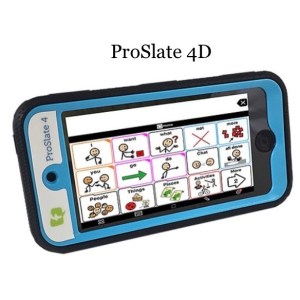
ProSlate 4D: https://www.forbesaac.com/proslate-4d (Updated 10/23/22: Sadly this device is no longer available. I contacted the company and they are still looking for an alternative since the iPod Touch that was used to build it was discontinued)
Update 3/19/25: It looks like Forbes *might* be offering a ProSlate 6D MAX (but the photos still show the older item that was discontinued, I’ll be watching for more info about this): https://www.forbesaac.com/proslate-6d-delete
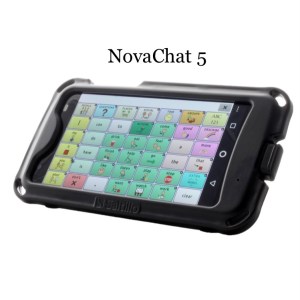
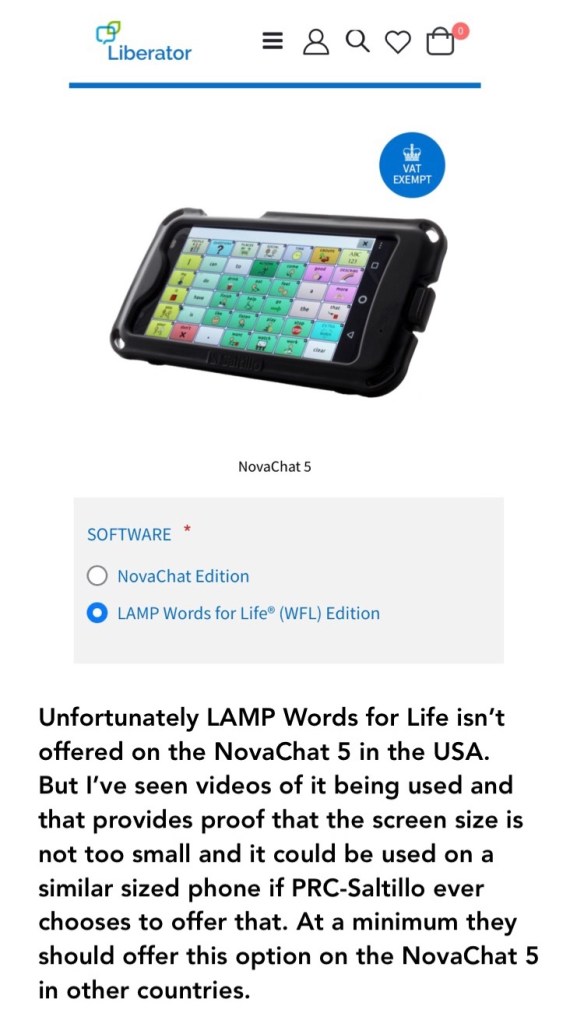
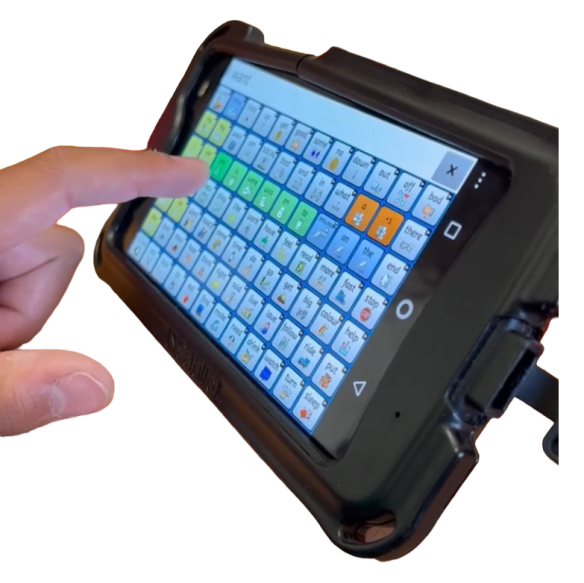
NovaChat 5: https://saltillo.com/products/print/nova-chat-5 (limited to their vocabulary options). (Updated 10/23/22:This device is still available. It’s an Android-based device so it wasn’t impacted by the disappearance of the iPod Touch.
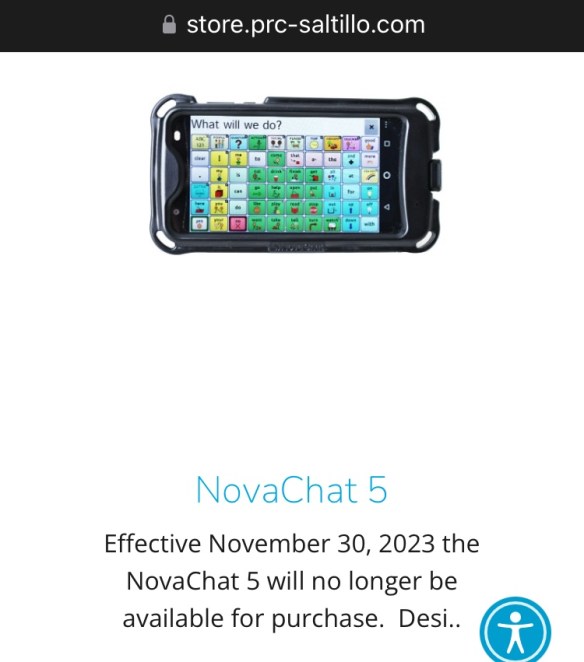
Updated 9/19/23: According to the PRC-Saltillo website effective November 30, 2023 the NovaChat 5 will no longer be available for purchase. I’ll update this post once I get official word regarding any new pocket-sized SGDs from this company. )
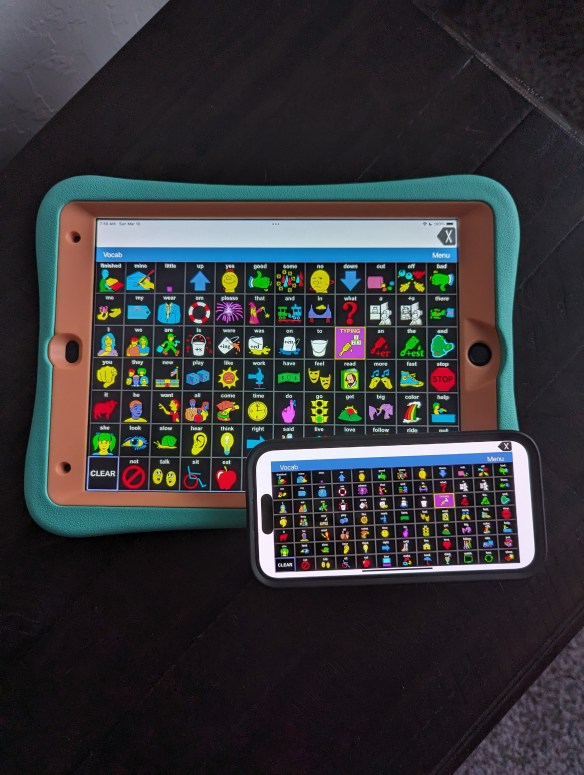
Updated 3/10/24: LAMP WFL is now available as an iOS Universal app so it can now be downloaded on an iPhone. Here’s a look at it beside my iPad.
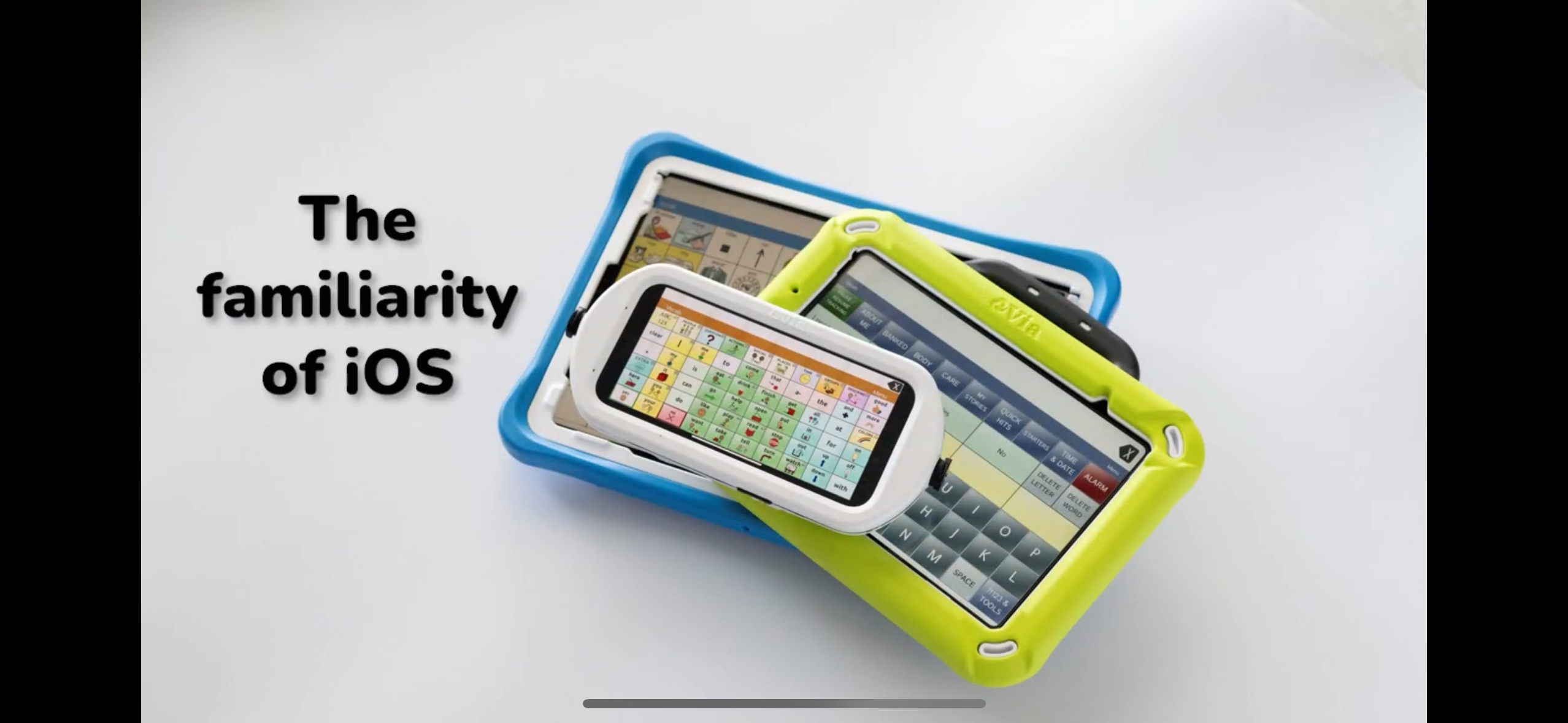
Update 1/24/25: Just saw the PRC-Saltillo Via Nano pocket-sized AAC device announced on the PRC-Saltillo YouTube channel. Glad to finally see them have a pocket-sized option again.
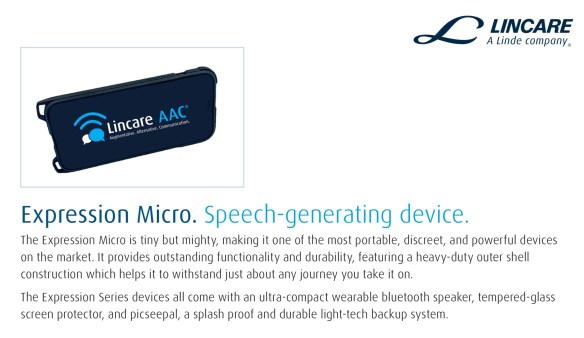
Lincare AAC – reportedly has a pocket-sized device called the Expression Mini Max but there isn’t any info about it on their website. I’ll update if I receive info about it. (Updated 10/23/22: The Lincare AAC website has been updated and now shows a small device called the Expression Micro. But there is just this picture and no info. I’ve messaged my contact at the company and will update this section when/if I receive any details: https://www.lincare.com/en/services/speech-generating-devices
Update 5/10/22: Apple announced today that they are discontinuing the iPod Touch. It will be interesting to see how this affects companies that have used that to build pocket sized AAC devices.
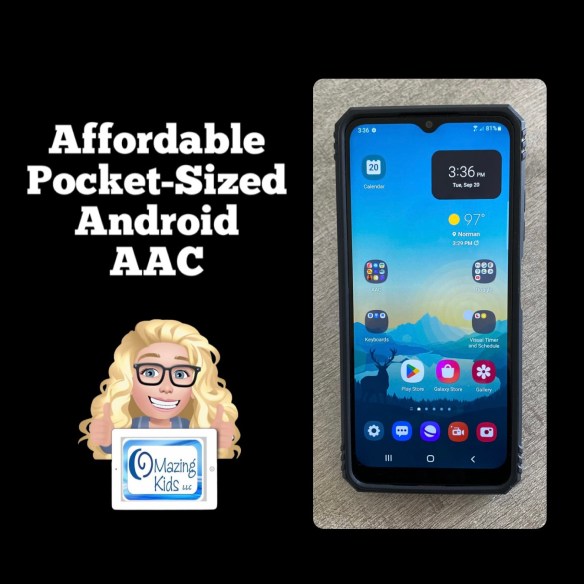
Looking for anaffordable option for pocket-sized AAC?Many users prefer to just add an app to their iPhone or Android phone but some settings don’t allow phones (or it would be a battle to get an exception). The iPod Touch used to be my “go to” option for this. Since the iPod Touch was discontinued I purchased anAndroidSamsung Galaxy A03s(prepaid TracFone that has NOT been activated for cellular service) on Amazon. Shout out to Karen Erickson for sharing that idea in a comment in the AAC for the SLP group.It was only $59.88and essentially gives me an Android equivalent to an iPod Touch (which Apple has discontinued) for pocket-sized AAC. I added a$12.99casethat has a tiny ring stand and sliding cover for the camera.So for $72.87 (+ the cost of the app) I have a very affordable pocket-sized AAC device.
Of course there are lots of other fundable larger tradional SGDs. Check with your local AAC vendor reps to discuss those options. There are also several pocket-sized or wearable mid-tech devices that could be considered.
Update 7/5/25: I have deactivated 4 handouts on TPT and am working on a new free handout that will have all of the information in one handout. I’ll announce when that’s ready.
————————————————————————————————————
{AAC Tips} How SLPs can get FREE access to AAC apps, AAC app user groups, funding options & more! (2021 Edition)
I’m doing a simplified version of this blog post. Each section will now be a separate blog post and then will be listed alphabetically and linked here. The focus continues to be on iOS AAC apps but there will also be some linked posts about AAC options on other platforms (Android, Windows, Amazon Kindle Fire, etc.).
An AAC eval should include consideration and trials of traditional SGDs. You can contact your local AAC vendor reps for training and to borrow an SGD for short term loan.
A good AAC eval should also include consideration of features uniquely available in AAC apps but folks don’t often know how to get access to those. So I continue to feel the need to share info about that to help my fellow speechies build a better equipped AAC toolbox. I retired from clinical practice and am now doing AAC consulting.
The problem is even if there is a free or low cost lite version of a particular AAC app, it is not the same as trialing the full featured app. How can you do a true feature-match when you don’t have all the features? Many SLPs see the prices in the App Store and assume they would have to personally purchase apps or try to get their facility or school to do so. Well unless you work in some mythical setting with unlimited funds or have a well established booming private practice, it’s unlikely that you would be able to afford very many AAC apps. Not saying they are overpriced. App developers have significant costs related to keeping robust AAC apps updated and paying licensing fees for high quality symbol sets and voices. So we shouldn’t expect these apps to be priced at the same level as other speech therapy apps or kids educational apps.
Update 8/24/20: Set up a free MyTobiiDynavox account and go through the steps to verify your status: https://www.mytobiidynavox.com/#/morestuff/professionals. Look on their website and Facebook group for current resources. Their website changes frequently so if any links are not working do a search on their website or ask in their group.
See these posts for info about how to activate the free voice output in the free version of the app:
1/13/21: See this video on the Tobii Dynavox Technical Support YouTube channel regarding how to fix the voice output if it’s not speaking: https://youtu.be/dE4Zkr6ev5w
11/22/20 Updated post about how SLPs can activate voice output in the free version of the Snap Core First AAC app
Update 11/10/20: Snap PODD & Snap Gateway have been added and SLP’s with a verified MyTobiiDynavox for Professionals account can access both for free within the Snap Core First app. See step by step tips on how to access these on this post: https://www.facebook.com/174264525957894/posts/3622621321122180/
.
They also have this free companion app filled with videos, tutorials and tips. It’s a very large app so make sure you have plenty of free space and a strong WiFi connection before downloading: Pathways for Core First by Tobii Dynavox LLC, https://itunes.apple.com/us/app/pathways-for-core-first/id1187433636?mt=8
But don’t stop there. You need more than 1 tool in your AAC toolbox. If you are a SLP that frequently does AAC evals and makes purchasing recommendations, then many other AAC app developers will provide you with a free promo code for their app so you would be able to trial it with patients.
How to get codes for AAC apps: The process for doing this is a little different for each app. I always start by contacting that developer via Facebook messaging on their FB page for that app. If I don’t get a response there, then I look on their website for an e-mail address or to see if they have a formal process for requesting a copy of the app. This info can be difficult to find so dig a little. It takes some time but is well worth it. I am a SLP at a non-profit facility that does tons of AAC evals and purchasing recommendations. I have been able to get most of the main AAC apps and therefore have lots of options to trial during AAC evals. Feel pretty tech-geeky spending evenings and weekends doing this but it’s worth it to have access to lots of AAC options that then result in good AAC matches for the kids I serve.
Update 8/24/20: I am now retired but am staying up to date on features in AAC apps in case I decide to do some consulting work and so I’ll be equipped in case any family members ever need AAC. . Here is an alphabetical list of AAC apps that I have gotten by going through this process and the way(s) I contacted those app developers. I hope I haven’t left anyone off the list. If I have, feel free to send me a message. There is not room to keep all the AAC apps loaded on my iPad at the same time so I rotate them on/off based on my patient’s needs. Most AAC apps are very large so I always suggest that SLPs get an iPad with the largest memory you can afford. Even with two 128GB iPad Airs, I am still constantly playing the “app shuffle” where I delete apps to make room to install others. I will be updating this list as I get new AAC apps:
aacorn & aacorn+ (Facebook messaging)
AAC Genie (Facebook messaging)
AlphaTopics (Facebook messaging)
Avatalker (Facebook messaging)
Avaz Pro (combo of Facebook messaging & e-mail)
BridgeBuilderAAC (Facebook messaging)
Click ‘n Talk & Talk’n Photos (Facebook messaging)
Clicker Communicator with SymbolStix & Clicker Communicator with PCS (Facebook messaging)
CoughDrop (the app developer contacted me)
Custom Boards (Facebook messaging)
GoTalk Now Plus by Attainment Company (combo of Facebook messaging & e-mail)
GoVisual Scene Maker by Attainment Company (e-mail)
Grace – Picture Exchange for Non-Verbal People (the app developer contacted me)
Grid for iPad by Smartbox Assistive Technology (combo of Facebook messaging & e-mail)
iESLp (combo of Facebook messaging & e-mail)
image2talk (Facebook messaging)
InnerVoice (Facebook messaging)
LAMP Words for Life (combo of Facebook messaging & e-mail. The key was to reach out to the app developers John & Cindy Holloran directly. I spent over a year with no success contacting PRC. You have to go through LAMP trainings prior to getting a code. Updated 8/24/20: new link to application: https://aacapps.com/partners/apply)
Make a Choice – AAC Buttons by pkclSoft (received a promo code after helping to beta-test this new app)
Mighty AAC (got it while it was free)
My First AAC (e-mail)
Niki Talk, Niki Talk + Tweet, Niki Music (adapted way to play music) & Niki Video (adapted way to play videos) (Facebook messaging)
PECS Phase III & PECS IV+ (e-mail – I had helped coordinate bringing a PECS workshop to our facility so that definitely helped)
Picture AAC (Facebook messaging)
Predictable, Scene & Heard & ChatAble (combo of Facebook messaging & e-mail)
Proloquo2Go & Proloquo4Text (AssistiveWare provides a free copy of the iOS and Mac versions of their AAC apps to Speech-Language Pathologists who conduct AAC evaluations on a case-by-case basis. Because they get a limited number of codes, they typically have a waiting list and prioritize requests based on caseload and geographic location. To request getting on that waiting list, SLPs can e-mail support@assistiveware.com. This same process applies to their simPODD app but it provides SLPs with a 1-year subscription (doesn’t include printing) and they will need to request access to simPODD each year).
Say Some More AAC Plus (combo of Facebook messaging & e-mail)
SayIt! (text to speech) (Facebook messaging)
See Me Talk (combo of Facebook messaging & e-mail)
simPODD (e-mailed AssistiveWare at support@assistiveware.com – received a free One Year Digital subscription – cannot print)
Snap Scene (it took multiple attempts to finally get connected with the right person at Tobii Dynavox to get a code for the full version)
So Much 2 Say (Facebook messaging)
Speak For Yourself (Facebook messaging)
Talk Tablet US (contacted this e-mail address: gusinc@me.com. Updated 8/24/20: That version of the app is no longer available for purchase. Instead they have a TalkTablet LITE – Eval Version for $1.99 and a Pro paid version. I don’t have either of those)
Tools2Talk+ (combo of Facebook messaging & e-mail)
Total Talk (e-mail) (Update 8/24/20: the app disappeared for several months from the App Store and then a revamped version relaunched as Talk Suite Pro)
TouchChat HD with WordPower (contacted my local Saltillo rep via e-mail. Find your rep: https://saltillo.com/reps. A word of advice… You really need the version that includes WordPower)
Verbal Me & Verbal Me Español (website contact form)
The key is being persistent. If one contact method doesn’t work, then try another. Another key is building relationships on social media. I put quite a bit of time and effort into liking and sharing posts from app developers pages, announcing when they have app sales and even doing reviews and hosting giveaways for them on my blog and social media sites. Some app developers may require proof of you being a SLP (keep in mind that they may have received numerous requests for a free app from parents or AAC users). The other thing to keep in mind is that app developers only get a certain number of promo codes when they release an app or an update to that app. So if they currently don’t have codes, check back again later. Often good to ask right after an app has been released or it has been updated when they would have a fresh batch of codes. . Despite numerous attempts, I have not yet been successful in getting access to the full version of following AAC app. Which means I can’t recommend it since I have no way to trial the full featured version during an AAC eval nor do I recommend it when therapists or parents ask about AAC options in the numerous Facebook groups that I participate in since I haven’t used it:
Sono Flex (the free lite version has some interesting features but can’t make purchasing recommendations off that for the full app. The app has not been updated since 2014 so it will be interesting to see if still exists after iOS 11 is released. Updated 8/24/20: they finally updated that app in March 2018 but have made it clear that their focus is on updates and support for their Snap Core First app)
.
Other AAC apps that I have and use:
2Talk – AAC (got it while it was free)
AAC Expression Toolkit
Alexicom AAC (free. They also have several different paid apps. The app developer has indicated that they have purposefully released several apps specific to certain ages, genders & symbol types to keep the app sizes small and affordable. They will be adding info to their website to help SLPs and parents figure out which app might be best suited to a particular user. Update 8/24/20: This app developer also has several apps specifically designed for adults in medical situations.)
BRIDGE Communication – both the Lite and Pro versions (bought both when it they were on sale, it has some cool articulation pages built into it, can add video clips to buttons, several other unique features, has a Spanish option in the settings, has SymbolStix symbols, has a history of being updated frequently, price is very affordable for an app with this many features)
CanTunes (free, music choice boards, adapted means of accessing music on your iPad)
CardTalk (free & got the IAP to unlock all functions while it was free)
ChatterBoards AAC
ChoiceBoard – Creator
Choice Board Maker
Choice Boards
CommBoards
Communicate Easy
Communication Adventure – An app for communication training for caregivers of children with complex communication needs
CoreVoice – AAC Core Board
EESpeech Basic
Emergency Chat
Flip Writer AAC (and the Flip Writer Pocket iPhone version)
FreeVOCA
GoTalk Now Lite (free, has good features for a lite app. Often recommend it as an option while we are working on getting other options in place)
Grid Player
iHear PECS: Animals (bought it, a bargain for $1.99)
iSpeak Button Collection (bought it, $5.99, large full screen round button (looks similar to a BigMack), swipe screen to see the next button, up to 15 buttons)
Leeloo AAC – Autism Speech App
LetMeTalk
MenuAssist (free)
MyTalkTools Mobile Lite
PAROL (Has several additional features that are cool: an interactive pain scale (same content as the Doloris app that disappeared from the App Store several years ago), a visual timer, a visual sequence page, the ability to print a PDF of picture symbols, etc.)
PAROL Mini
PhotoVOCA (had gotten an older version while it was free… then was able to udate to the new version for free)
PictoMaker
Picture Card Maker PLUS (got it while it was free. The app developer is in the process of releasing a major update for it)
PlayButton (free, https://appsto.re/us/WZ2lC.i. This FREE app is one of my faves for use as a single message VOCA. The activation area is very large (almost the entire screen). I use Guided Access to lock the “record” button to prevent accidental activations during use. Update 8/24/20: They added a place in the iPad Settings for this app to toggle off the recording button)
Posco AAC
Quick Type AAC (bought it, a bargain for $1.99)
Smooth Talker AAC
Sono Flex Lite
SoundingBoard (free)
Sorenson BuzzCards (type and show, no voice output, designed for hearing impaired to use to quickly communicate with those who don’t know sign)
Speak – Text to Speech
Spell Better – Literacy Support (includes text to speech)
Spuble – creating live speech bubbles (very unique voice to text app that transcribes what a person says so another person can read it on the screen)
SymboTalk – AAC Talker
TalkBoard Free
Talk For Me – Text to Speech
Talking Button by Masanori Kubota (got while it was free)
Tap Chat
TapSpeak Button Plus (won it in a giveaway on PrAACtical AAC)
Tom Taps Speak – AAC for Kids
Touch Switch (bought it, $4.99, play any music downloaded onto your iPad with full screen round button. Also plays eye catching animations. Really more for “cause & effect” but thought it was worth mentioning)
Verbally (free)
Voice4u TTS
Whiteboard – nothing more, nothing less
Widgit Go Basic
YesNo – questions made simple
Yes or No Communication
Yes/No
Yes / No Button Free
There are several other AAC apps that I have gotten when they were free for a day or two. When I see one, I download it to try out before deciding if it is worth sharing on social media. There are some apps in the App Store that claim to be AAC but are so poorly designed that I chose not to post about them.
Updated 8/24/20 – AAC apps for communicating about pain & medical situations:
PAROL by Les Applications C, Inc https://apps.apple.com/us/app/parol/id1472197509 (has an interactive pain scale with same content as the Doloris app that disappeared from the App Store several years ago)
Updated 8/24/20: Keyboard Extension Apps: It may be helpful to consider using a keyboard extension app that would make the iOS iPad Keyboard easier to use with features that are special needs friendly.
Keedogo by AssistiveWare, https://apps.apple.com/us/app/keedogo/id915829477, $.99 (My favorite keyboard extension app with lots of customization options. Good for beginning typists since it doesn’t have word prediction or auto correction. If you want additional features the look at the next two apps….
SuperKeys Accessible Keyboard by Crick Software, https://apps.apple.com/us/app/superkeys-accessible-keyboard/id917216287, $12.99 (A very unique keyboard that enlarges quadrants and then you select a large key within it. Nice for those with vision or fine motor needs but can also be helpful for those overwhelmed by looking through the entire field of keys. The SuperKeys keyboard is built in as an option in all of the Clicker Communicator AAC apps. Phonics Keyboard by Therapy Box Limited, https://apps.apple.com/us/app/phonics-keyboard/id1031514501, $2.99 (There are also some fun activities within the app)
SwiftKey Keyboard by SwiftKey, https://apps.apple.com/us/app/swiftkey-keyboard/id911813648, FREE (for more advanced typists who want a full PC style keyboard with the ability to customize the color for sensory needs, customization options, ability to swipe to type, has a nice “real keyboard” feel, the description shows IAPs for additional keyboard styles but as far as I can tell everything is included now. I’m currently using the “Nickel Classic Dark” theme as a nice alternative to the iOS iPad keyboard.)
FYI… There are a few AAC apps that use the iOS iPad Keyboard and therefore would allow for a keyboard extension app to be used. Examples include: Speak for Yourself, Proloquo2Go, Mighty AAC, ChatAble, Proloquo4Text, Predictable, Voice4u TTS, QuickType, Flip Writer, HandySpeech and several other text-to-speech (TTS) AAC apps. Exploring alternative keyboards can be a game changer for making typing as a means of AAC accessible. You may also want to explore accessibility features in the iPad settings (https://support.apple.com/guide/ipad/get-started-with-accessibility-features-ipad9a2465f9/ipados), styluses, adapted styluses, keyguards, external Bluetooth keyboards, etc. Take a look at Lauren S. Enders’ well organized Pinterest boards for ideas: https://pin.it/TWn9w6P (styluses: https://pin.it/t4cy8XV; keyboards & keyboard cases: https://pin.it/NydPTE8). I highly encourage you to collaborate with an Occupational Therapist and/or Assistive Technology Specialist when exploring AT options for the iPad. Some of that equipment is pricey so you want to make good decisions that fit that individual child’s needs. You may want to try things out in order to make those decisions. Check with the AT Lending Library in your state: https://www.at3center.net/stateprogram. Many have iPads, specialized apps and AT equipment available for short term loan to try out before making purchasing recommendations.
Free web-based AAC open source options (can be used online and some offer an offline option, may work across platforms):
* AsTeRICS Grid – open source web-based AAC: https://grid.asterics.eu/#welcome. Has the option to set up offline users. Uses voices available on that device or platform. On my iPad the iOS voices showed up as options. The editing is different from what I’m used to so there is a learning curve to get up to speed. Just beginning to explore this option.
* CBoard – open source web-based AAC: https://www.cboard.io. Cboard works on modern browsers and is available on a wide variety of platforms, including desktops, tablets and mobile phones. Offline support is available on Google Chrome (desktop & Android). There is an Android app (see above). Support for up to 33 languages (vary by operating system). Uses open source Mulberry Symbols. More info about features (vary by operating system): https://www.cboard.io/help/#Features & info about how to program and use it: https://www.cboard.io/help/. FYI…. you’ll want to do some editing if you are in the USA. Several of the items are named differently here (ex: biscuit -> cookie, ice lolly -> popsicle, chips -> fries, crisps -> chips, etc.).
* OptiKey – open source Windows eye-tracking and communication tool: http://www.optikey.org, https://github.com/Optikey/Optikey/wiki. Optikey is an assistive on-screen keyboard which runs on Windows. It is designed to be used with a low cost eye-tracking device to bring keyboard control, mouse control and speech to people with motor and speech limitations, such as people living with Amyotrophic Lateral Sclerosis (ALS) / Motor Neuron Disease (MND). Includes support for the CommuniKate symbol communication boards. More info: https://github.com/Optikey/Optikey/wiki/Support-for-CommuniKate-boards & http://communikate.equalitytime.co.uk. CommuniKate is designed for people who rely heavily on the environment or context in order to communicate effectively but understand concepts and language used in conversation and during everyday activities.
Affordable web-based AAC open source option (can be used in a web browser online and works in apps across multiple platforms – iOS, Android, Amazon Kindle, Windows):
CoughDrop – open source cloud-based AAC: https://www.mycoughdrop.com. They offer a free 2-month trial. After that it’s either a monthly subscription (currently $6.00 per month). Info about other pricing options: https://www.mycoughdrop.com/pricing. They often offer a 50% off discount on the Lifetime Subscription fee in April (Autism Acceptance month) & October (AAC Awareness month). They frequently add new board options and do a good job of keeping the app updated. This is the only affordable AAC option that I’ve seen that can send the text and symbols together in a cohesive message via iMessaging and e-mail. Other higher priced AAC options that can send both symbols & text as a cohesive message: Avaz (in iMessaging and e-mail) and the Clicker Communicator apps (as a PDF either by AirDrop or e-mail. MyTalkTools is the only AAC app that I’ve seen that actually has an iMessaging app component where the app works within iMessaging… but each symbol is messaged separately.)
Windows: You can install CoughDrop as a Windows desktop app on your computer or Windows device. CoughDrop on Windows has some eye-tracking integrations that will help it work better with more devices. Please make sure to download the right version for your operating system. https://www.mycoughdrop.com/download
Web Browser: CoughDrop is a web-first application, and should work with many modern web browsers.
What are my “favorite” AAC apps? I have several based on the features available in them. I know the list above looks overwhelming and I did not get these apps all at the same time. So here is some advice as to where to start in your quest to acquire AAC apps. If I had to narrow down the list to the top 10 robust AAC apps that stay loaded on my iPad all the time and have been a good match for several patients that I serve… they are (list updated 8/24/20 – subject to change as apps are updated with new features and other apps are released):
Avaz Pro
Clicker Communicator with PCS (and the version with SymbolStix)
CoughDrop
GoTalk Now Plus
Grid for iPad
LAMP Words for Life
Proloquo2Go
Snap Core First
Speak for Yourself
TouchChat HD with WordPower
I think of these as the most common tools in my AAC toolbox (like a hammer, pliers, saw, tape measure, drill, level, screwdriver & wrench are common tools at home). The rest are still very important “specialty” tools in my toolbox. They are fabulous for meeting less common and very specific needs. Think of an Alan Wrench. Not something you use very often but when you need one it is the only tool that will meet that need. And sometimes the best solution is a combination of several tools. Remember…. Good builders pick tools based on the task.
Feature Matching:
So I bet you are thinking “oh my goodness… how on earth can I learn about all the features to do a feature-match with so many options?”. The apps I have listed above are just the tip of the iceberg. There are hundreds.
Updated 8/24/20:
The best way to keep up to date on the features in AAC apps is to have access to them and use them frequently. You can also gain helpful info in the user groups for apps on Facebook, videos released by the app developer and several resources listed below:
SET BC Supported AAC Device Comparison Chart April 2019 (their documents only include info on the apps and devices that they use but is still a helpful example and fairly recent): https://bit.ly/31qPo42. They also have a Feature Matching: Linear and Auditory Scanning (February 2019): https://bit.ly/32nIP1E & SET BC AAC Software/Apps with Visual Scenes: Comparison Chart (February 2019): https://bit.ly/3jcykF1
FYI…. features change rapidly as apps are updated or companies release new devices. So as soon as any resource list like these are published it likely already has something outdated in it.
But finding fairly recent documents like these at least gives a good starting point when comparing options in a feature match process. Tip: If a document you find online isn’t dated be sure to look at the iOS requirements listed in the features. There are VERY old charts that date back to iOS 4 that I saw that are totally outdated and are not an accurate or fair depiction of those apps.
FYI 2: I haven’t found any document that contains info on every AAC app or device so it’s important to research and consider ones that may not be on a particular list.
This Feature Match Comparison Chart from the Oklahoma Assistive Technology Center is helpful: https://bit.ly/3hs27cl
http://bit.ly/EndersAACAppsPart1 . AAC APPS: Considerations for Selecting, Customizing, & Getting Started – Part 2 – Lauren Enders (May 15, 2019) – includes 2 robust motor-plan based AAC apps (LAMP Words for Life & Speak for Yourself), 1 robust cloud-based app that’s a mix of folder-based with influences of motor-planning (CoughDrop), plus info about other types of AAC apps (including a nice overview of unique ways to use the GoTalk Now app)
http://bit.ly/EndersAACAppsPart2 . Also this archived presentation by Christine Baudin: Comparing & Contrasting 5 Common Robust AAC apps – TouchChat with WordPower (focusing on 108 & 20 location page sets), Proloquo2Go (focusing on 7×11 grid), Snap Core First (focusing on 8×10 grid), LAMP Words for Life (84 location) & Speak for Yourself (120 location) – 2018 AAC in the Cloud
Unfortunately the AAC Ferret app that had been so helpful in searching for apps by specific features no longer exists. Word is the app developer ran into funding issues. Even if you still have that app loaded on your iPad, it no longer works. That app truly was a fabulous tool. My hope is that maybe it will reappear one day or that someone else will develop a tool like that.
My next “go to” resource used to be Jane Farrall’s website with her AAC app lists (http://www.janefarrall.com/aac-apps-lists/). Unfortunately she took that part of her website down since she no longer had time to keep updating it and the lists were outdated. It used to have several amazing lists:
Symbol/Picture apps – These are apps that have symbol based pages but don’t make text-to-speech available to the person who uses AAC.
Symbol & Text Based apps – These are apps that have symbol pages and make text-to-speech available to the person who uses AAC.
Text Based apps – These are apps that make text-to-speech available to the person who uses AAC or that have text only communication pages.
.
Funding:
Wanting to get a bundled iPad with an AAC app in a durable case funded as a “dedicated” SGD through Medicaid or insurance? Your best bet is to check with the funding departments at these companies. They all offer iOS based devices with a variety of AAC apps as an option:
We are fortunate in Oklahoma that Medicaid will consider funding an iPad with a robust AAC app in a durable case as a SGD / DME but they require us to try the full version of the app in order to do a complete feature-match, submit a video of the patient using it and extensive justification as to why that particular option us being recommended. Here in Oklahoma, we can only get funding once every 5 years for AAC (with very rare exceptions) so it’s very important to be able to get a good match for that individual’s needs. See details here: https://www.okabletech.org/community/soonercare-provider-for-speech-generating-devices/
Another source that I’ve had good success with for funding an iPad with a robust AAC app in a durable case here in Oklahoma is the New Voices grant through Ability Connections Oklahoma: https://www.acok.org (the funding comes and goes on this grant. See their Facebook page for updates: https://www.facebook.com/abilityconnectionoklahoma/).
There are key times of the year that AAC apps tend to go on sale and I always share that info on my OMazing Kids Facebook page and in the AppPeeps group. Some app developers choose to do sales and others do not. When I have inquired about that, they reply that they feel their app is fairly priced given the ongoing costs related to keeping it updated and licensing fees for symbol sets and voices.
Why do many AAC apps cost so much? Drives me a little nuts when I see unkind comments regarding pricing of well designed AAC apps. Where else would we demand that something be put on sale or even worse demand that it should be free? Really?! The well designed robust AAC apps are a bargain even at full price if you stop to really think about being able to get a “voice” for a patient for a tiny fraction of the cost of traditional SGDs. It has been a game-changer and allowed many parents to be able to no longer have to wait on a SLP to be the decision maker / gatekeeper. Many parents post about “going rogue” in buying an iPad, AAC app & durable case for their child after being told they weren’t “ready” for that. News alert…. the old school mentality of there being a “hierarchy” that a child has to go through to “prove” they are “ready” for robust AAC is antiquated. Not saying that every AAC app or SGD is a good match for every child but I am saying that the days of kids with very complex needs being stuck with just a single message VOCA or a few PECS symbols have to end. See this presentation from Jane Farrall: http://www.janefarrall.com/lets-communicate-plenary-presentation-at-qaselcon16/ , this post about “What is “Beginning” AAC?“: http://www.janefarrall.com/what-is-beginning-aac/, and this powerful post on the Uncommon Sense Blog’s Facebook page: http://bit.ly/230RT5r. .
What about parents who want to try out AAC options? I highly recommend that you pursue an AAC eval with a SLP who has expertise in this area. Many larger school districts have an AAC team. But don’t feel that you have to wait if you are a parent who has been told “no” and want to proceed on your own. It may just be a little trickier to determine what the best AAC option will be for your child since most parents don’t have unlimited resources to buy several AAC apps to try. All states in the USA are supposed to have an Assistive Technology Lending Library program where parents & professionals can borrow AAC devices, iPads with AAC apps & other AT for short-term trial. It’s a great way to try various options out before making purchasing decisions. There are lots of great AAC devices and apps. It’s important to do a good feature-match and trial of options. Find the AT Lending Library in your state: https://www.at3center.net/stateprogram
The AT Program in your state may also know of SLPs who do AAC evals and funding resources specific to your area.
Need support with using an AAC app? Most app developers have a Facebook group for that app. I highly suggest joining these groups for an incredible amount of support from the app developers as well as other parents, therapists & teachers. Every group has it’s own “culture”. Some are very open to discussing any topic. Others are pretty strict about only posting info or questions directly related to that particular app. Here is a list of the Facebook app user groups (updated to include support groups for traditional SGDs & PODD):
I have suggested to the developers of the GoTalk Now app that a group be started but so far I’ve only seen a parent led one in Swedish. I have also suggested to the developer of the new Total Talk AAC app that they start a group. He was very open to the idea so I hope to see that soon.
There are also numerous other AAC-related Facebook groups. Again each having it’s own culture and dynamic. I’m not going to list all of those here…. but if you are a SLP, I definitely suggest joining the AAC for the SLP group: https://www.facebook.com/groups/1539830846285663/. Also take a look at the 21st Century AAC Practitioners group: https://www.facebook.com/groups/475548015977014/. If you see me “tag” Lauren Enders in a post or comment, it’s because I know that she has a wealth on knowledge about AAC apps, cases, mounting options, etc. You should seriously follow her on Pinterest: https://www.pinterest.com/lasenders/. I also know that she will provide an unbiased opinion and always comments in a very supportive way.
You may also see me “tag” Carole Zangari from PrAACtical AAC for the same reasons. http://praacticalaac.org/
.
{AAC Assessment} “Just like driving a car, when you’ve been doing AAC assessments for a long time, you almost don’t have to think about the details of what you are doing. I automatically pull out the devices and apps, YouTube, iPad, snack, bubbles and wind-ups, and start playing. Unfortunately, it is less than helpful to tell people new to AAC to just play with students and watch what they do. In an effort to describe our process, I created a data sheet to break down the steps, and typed up the procedures and suggested apps.” This post by Vicki Clarke from Dynamic Therapy Associates Inc on PrAACtical AAC is full of awesome tips for AAC assessment! I was excited to get new ideas for several apps that I already had and was inspired to buy an app that’s been on my “wish list” for awhile. I will also confess to buying the hippo toy pictured. It’s been on my “wish list” for awhile too (gotta love shopping on Amazon with free shipping). 😉
What’s the best AAC approach?What’s the best dedicated speech generating device? What’s the best case? What’s the best ______….. Several times a week I am either asked this question or I see it posted in one of the many AAC Facebook groups I follow. Occasionally it seems to end up in a rather heated debate of ______ vs. ________. Even arguments over core vs. fringe vocabulary. For a balanced approach in use of core & fringe vocabulary, check out this fabulous post on PrAACtically AAC: http://praacticalaac.org/praactical/the-baby-the-bathwater-and-core-vocabulary/. This is counterproductive. Although there are key best practices when considering AAC options, there is not any one best AAC option (or one best therapy approach, or one best anything) when it comes to best meeting individual needs. I have added a lot of tools to my toolbox over my 26+ year career as a speech-language pathologist. There have been pivotal moments where new tools were added that forever changed my perspective. Although shiny new tools may be exciting they did not replace the old tried & true tools. The exciting thing about tools is that you can use them together to build & repair. Would it make sense to ask “What’s better…. a hammer or a drill? a saw or a tape measure? a wrench or a flashlight? Of course not. Each tool has it’s specific purpose. You select the tool based on what job you need to accomplish. . Have questions? The quickest and most reliable way to reach me is via Facebook messaging on my OMazing Kids page. Thank goodness it seems to be immune from spammers unlike my e-mail. . Are you an AAC app developer? I’d be more than glad to help beta test your app and then post about it when it is released for sale. I don’t charge a fee. Just would need a free promo code for the full version of that AAC app so I can add it to my toolbox. I never post about apps that I haven’t tried out first. Oh and a word of advice to app developers… state run facilities and schools have difficulty with in-app purchases or subscription-based apps as do potential funding sources such as Medicaid or insurance companies. So you will have a wider audience if you also offer a full paid version of your AAC app.
.
I am asked pretty frequently for my thoughts on AAC app development. Here is my advice:
Any new AAC app needs to support robust communication for a wide variety of functions. There are already lots of simple choice making apps on the market.
Take a good look at the major AAC apps on the market and determine what specific features your new app would offer that are not already available.
Do lots of beta testing to insure the app is intuitive / easy to use. Even with the best intentions some AAC apps never take off. An example is Total Talk. It has several unique features but is not very intuitive to use and they initially only let you pick one voice (that has since changed but they lost the initial momentum that comes with a new app release). (Update: 8/24/20 – It was nice to see the Total Talk app revamped and relaunched as “Talk Suite Pro”. The app has some unique features so hopefully it will make it this time)
You only should offer an AAC app that is truly worth having and meets needs. There are several free or very cheap AAC apps on the market. But you rarely see them mentioned or recommended because they are so poorly designed.
Determine what platform you will develop the app for (iOS or Android). It’s very rare for app developers to be able to tackle both platforms and do it well. Most AAC app developers stick with the iOS platform because it is uniform and thus easier and less costly to develop apps for.
Beyond the initial costs of developing the app, make sure that you also have a very well thought out long term plan and finances for supporting and keeping an AAC app updated. I’ve received numerous messages on my OMazing Kids page from parents and therapist with very heartbreaking stories of AAC users losing their voice when iOS 11 came out. Several small AAC app developers had not updated those apps in almost 5 years. It’s one thing to lose a favorite game or therapy app but a whole different thing to lose an AAC app.
📥 Want to suggest iOS AAC apps to be added to this post? The best way to reach me is via Facebook messaging over on my OMazing Kids page.
If it’s a free app, please send the link from the USA App Store so I can download and try it out. If it’s a paid app and you are the app developer, please send the link from the USA App Store so I can look at the info before you send a promo code. I want to make sure that one of my iPads or iPhone is compatible in order to try it out.
If you see info or links that need to be updated on this post, feel free to send me a Facebook message on my OMazing Kids page.
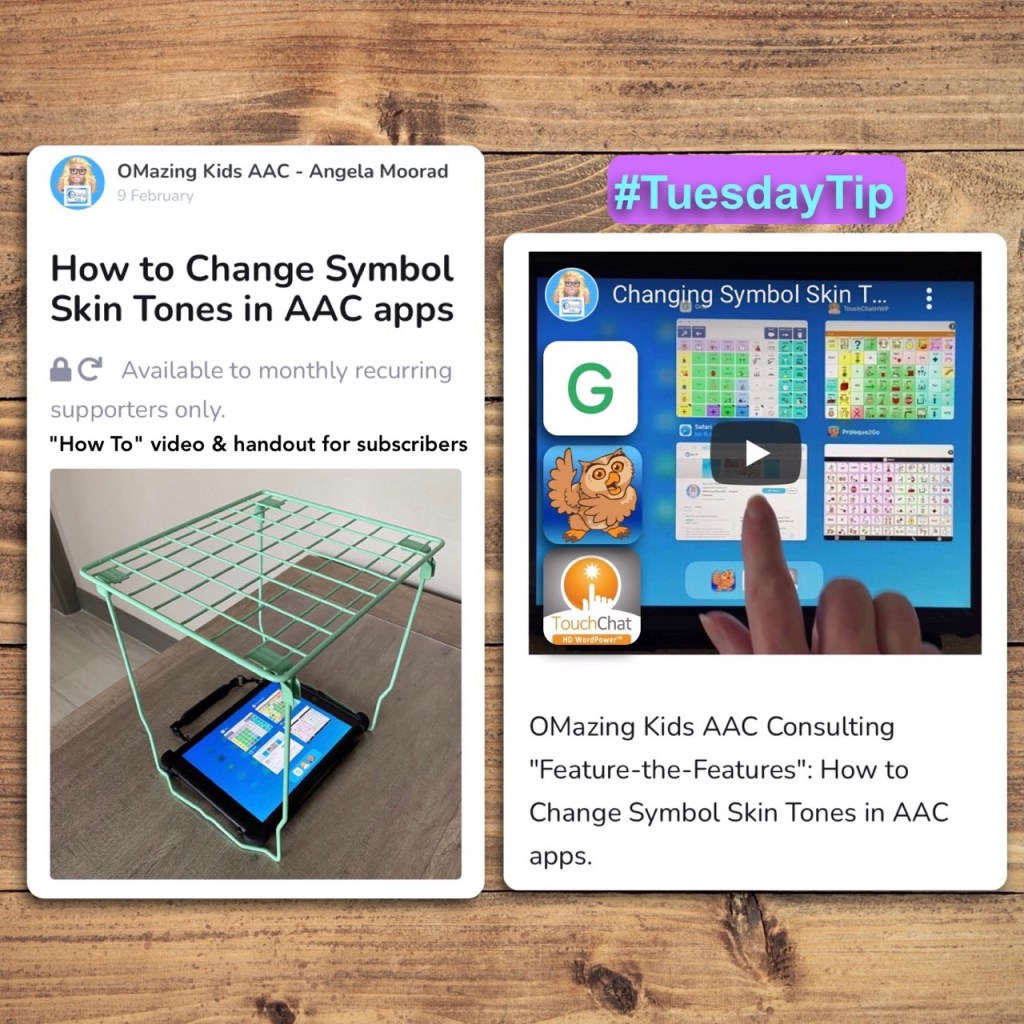
Did you know that you can change the symbol skin tones system wide in three robust AAC apps without the need for any add-on purchases or doing button by button programming?
Yup…. Grid for iPad by Smartbox Assistive Technology, Proloquo2Go by AssistiveWare & TouchChat with WordPower by Saltillo all currently offer this feature and several other app developers have it under development for release in 2021. Such a cool feature to support diversity in AAC 🙌🏾. Knowing that this feature exists is my free Tuesday Tip.
If you want to know more…. a short “how to” video and 1-page handout are available as exclusive content to monthly subscribers on my new Ko-fi page:https://ko-fi.com/omazingkidsaac
My Ko-fi page has a specific focus on providing information and tools for feature matching, short videos highlighting features in apps, ways to incorporate books and toys to keep AAC fun, etc… with a very small $4 per month subscription to cover tech expenses and time to keep resources up to date/sustainable.
Personal Professional Facebook Page (linked to OMazing Kids): https://www.facebook.com/angela.moorad (adding “friends” who have a direct role in AAC or Assistive Technology – AAC / AT app or product developers, AAC / AT consultants, SLPs who specialize in AAC, other professionals who specialize in AAC or AT, etc.)
The PDF in the “The iPad & the SLP in 2020 and Beyond: Interactive PDF Resource List of iOS apps, Boom Cards, Teachers Pay Teachers materials, Teletherapy Resources and Online Resources – organized by goal areas, themes and topics” blog post was updated today (1/14/21).
What’s New:
• Updated link to the various grid sizes of printable Snap Core First communication boards (in AAC section)
• The Bookish AAC’s YouTube channel & Mr. Clay’s YouTube channel (added in AAC section with COREaoke links)
• AAC Parent Coaching YouTube channel (in the Parent Activities section)
• Tools for Clear Speech video modeling for placement (in Articulation section)
• Body Parts – No Print Interactive PDF (in the Basic Concepts section),
• LiveWorksheet website (in the Create Own Materials section)
• Wordless Short Videos for Language Therapy & AAC LAMP Vocabulary Teletherapy EdPuzzle: Wordless Animation (in the Inferences section)
• Scattergories and Cognishine (in the Online Games section)
• WH-Question Paragraph Stories with Who, What, Where, When Questions (in WH questions section)
• Updated social media links for OMazing Kids
The original PDF was deleted and the new one uploaded.
So anyone who had saved the PDF to their iPad or computer will need to delete the old one and save the new one to have the most current info.
Personal Professional Facebook Page (linked to OMazing Kids): https://www.facebook.com/angela.moorad (adding “friends” who have a direct role in AAC or Assistive Technology – AAC / AT app or product developers, AAC / AT consultants, SLPs who specialize in AAC, other professionals who specialize in AAC or AT, etc.)
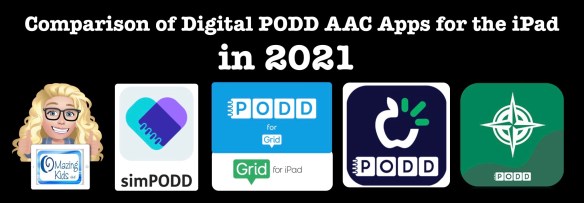
Review & Comparison of Features in Digital PODD iPad apps in 2021 (simPODD, Grid for iPad, TD Snap and PODD with Compass)
I just updated my comprehensive blog post about PODD AAC to add Snap Core First with PODD to my in-depth review and comparison of features in all of the digital PODD iPad apps currently available in the USA App Store: simPODD, Grid for iPad, TD Snap and PODD with Compass. Rather than doing it in a separate post I decided to add it to that post to keep everything PODD related in one spot.
Updated info is highlighted throughout that post and I tested all links and updated those. Scroll down towards the bottom of the post until you see the same pic that is on this post to find the app reviews and comparisons of features:
. Want to suggest PODD resources or info to be added to that post? The best way to reach me is via Facebook messaging over on my OMazing Kids page. If you are an app developer and would like to have me review a new digital PODD app for the iPad or PODD that was added to an existing app via IAP, please send the link from the USA App Store so I can look at the info before you send a promo code. I want to make sure that one of my iPads is compatible in order to try it out.
Angela Moorad, MS, CCC-SLP, Founder of OMazing Kids, LLC
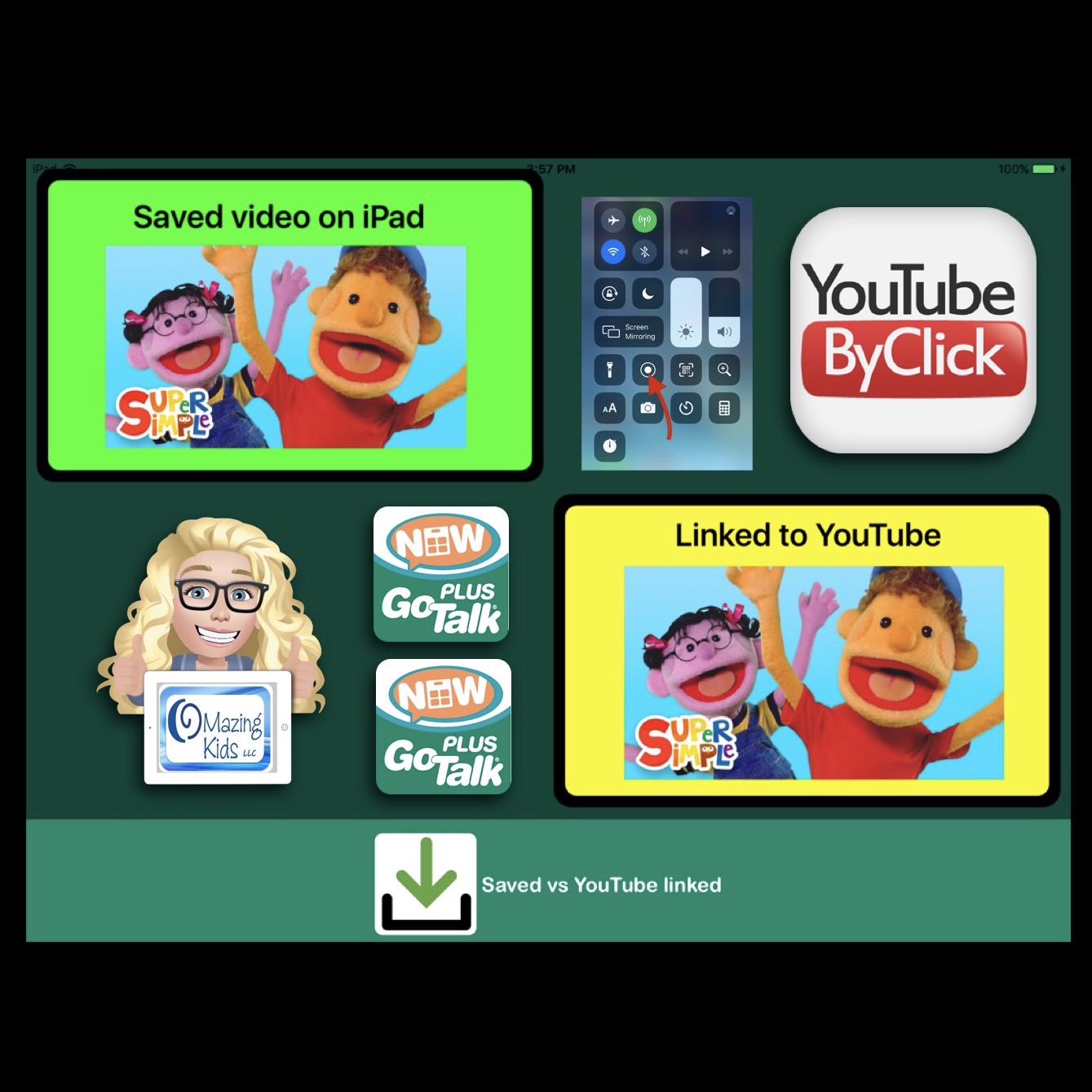
Why I prefer to save videos to the iPad vs. linking to YouTube when using the GoTalk Now app:
I had too many patients’ highly preferred videos disappear from YouTube. That typically triggered a meltdown or they lost interest as I attempted to find a different version of it on YouTube.
Saved videos play immediately (no delay = immediate reinforcement of that request). I had several patients who had been seen multiple times by various SLPs over the years at the facility where I worked and they never appeared to understand cause/effect or be motivated to communicate when in fact the issue was the reinforcement wasn’t immediate enough for them to form that connection.
See a side by side comparison in this video.
Also added the video to YouTube:
I used the Screen Recording feature in the iPhone Control Center to take a screencast video while I was playing the YouTube video to save it. Then I edited the video to crop off a little at the beginning and end. My iPad Pro running iOS 10.3.3 doesn’t have a Screen Recording option in the Control Center. My iPad Mini 2 running iOS 12.4.8 could record but didn’t have sound. I was able to do this via my iPhone 11 running iOS 13.5.1 and then used AirDrop to send it to my iPad Pro to use in the GoTalk Now Plus app. My guess is an iPad running at least iOS 13 would have sound in the screen recording but have no way to know for sure 🤷🏼♀️
Update 12/15/20: It is also possible to play saved and play linked YouTube videos within the TouchChat AAC app.
Here’s some differences between playing a “linked” YouTube video in GoTalk Now vs. playing a “linked” YouTube video in TouchChat:
In GoTalk Now, a button programmed to link to a YouTube video exits the app and takes you to YouTube on Safari (that would be blocked if using Guided Access or on a managed dedicated iOS based device). It would be difficult for most AAC users to get back to the GoTalk Now app (have to tap a tiny thing in top left corner of screen and if they play other videos that might disappear).
In TouchChat, a button programmed to link to a YouTube video opens it on a screen within the TouchChat app. It’s easy to tap “done” to return to the previous TouchChat screen. The linked YouTube video will play within TouchChat even when Guided Access is active. But you’d still have issues if YouTube is down or that linked video disappears from YouTube. I’ve used “linked” videos in both of those apps if it’s something I wanted to program on the fly in the middle of a session. If it turned out to be a highly preferred video then I went through the process of saving it to the camera roll and then programming to open it that way 😊
When using either app for this purpose I consider this to fall under the category of “Assistive Technology for Adapted Leisure”. So this is giving them an adapted means of accessing videos. I also use it as an adapted means of accessing music.
An alternative to using Screen Recording is to download free software onto your laptop that will allow you to download and save videos from YouTube and several other sources. I just tried out the YouTube ByClick software and it worked very well. The resulting video was a little larger on the screen than the one made via screen recording. But it involves having to use your laptop to download the video, e-mailing the video to your iPad and then saving that video to the Camera Roll. https://www.youtubebyclick.com.
Update 11/5/20: Here’s another option that worked directly on my iPhone: https://qdownloader.io
Update 11/4/21: Here’s an option that Lauren Enders shared: YT1s YouTube Downloader, https://yt1s.com/en65
[Note: Many of these websites or app disappear pretty quickly so that’s why I just use screen recording on my iPad instead. ]
I can see using YouTube ByClick when I want to save several videos ahead of time to prep for a session. But the Screen Recording method would be my “go to” for the convenience.
In a pinch you could even just use the iPad to video a YouTube video being played on a computer or TV. I’ve done that before. The quality isn’t nearly as good but the patient still enjoyed watching it.
Reminder: GoTalk Now & GoTalk Now Plus are both on sale through the end of October 2020. Extremely rare sale so if you’ve been wanting either of these apps NOW is the time to get it.
Update 9/30/21 – GoTalk Now Facebook Group – informal networking via the “GoTalk Now AAC App – Ideas and Sharing” group that I started on 9/29/21: https://bit.ly/GoTalkNowAACappGroup
Visual supports with voice output for the “win”! I attended a presentation by Kari Dunn Buron, coauthor of The Incredible 5 Point Scale, at the Oklahoma Autism Conference offered by the Oklahoma Autism Network in 2017 and was inspired to make this for a patient who had been having a particularly difficult time and exhibiting a significant increase in aggressive behaviors. I watched for very subtle signs of increased agitation and modeled use of this to both talk about emotional states and offered choices to help calm before he got beyond a “Level 3”. He showed understanding of it the very first day and smiled when I acknowledged that he was struggling. He chose “go for a walk outside” and “go back to the house and rest”. The next day he spontaneously tapped “go for a walk outside” before he got beyond a “Level 2” and a huge smile washed over his face as we exited the sensory overload inside the building into the brisk air and total peace outside. I was often totally overstimulated by all the “Christmassy” stuff at our facility too so we ended up taking lots of walks outside 😉.
A video showing several boards including this one:
Thanks again Attainment Company, Inc. for making such a versatile app and giving me access to the most full featured version as well as several extras within it to help the patients at the nonprofit facility where I worked for the last half of my career. I was able to show this to his mother and she was very impressed with how easy this app is to program and to use for AAC and visual supports.
This app is definitely in the top 5 most used apps on my iPad. I saved this to the Online Gallery. Those who have either the GoTalk Now or GoTalk Now Plus versions of the app should be able to find everything that I have uploaded to the public Online Gallery by searching by my last name (Moorad)or a word in the title. See page 23 in the in-app Users Guide for info on how to find it.
There are several versions of the app with varying levels of features:
Updated 4/3/22 to add: Encouraging Emotional Conversations in Children With Complex Communication Needs: An Observational Case Study (free access to the full research article & supplementary materials): https://www.frontiersin.org/articles/10.3389/fpsyg.2021.674755/full. The AAC app in the article is TD Snap but the concepts could be used when adding this type of vocabulary to any AAC system. If you have access to Grid for iPad / Grid 3, take a look at some nice preprogrammed content in the Voco Chat grid set.

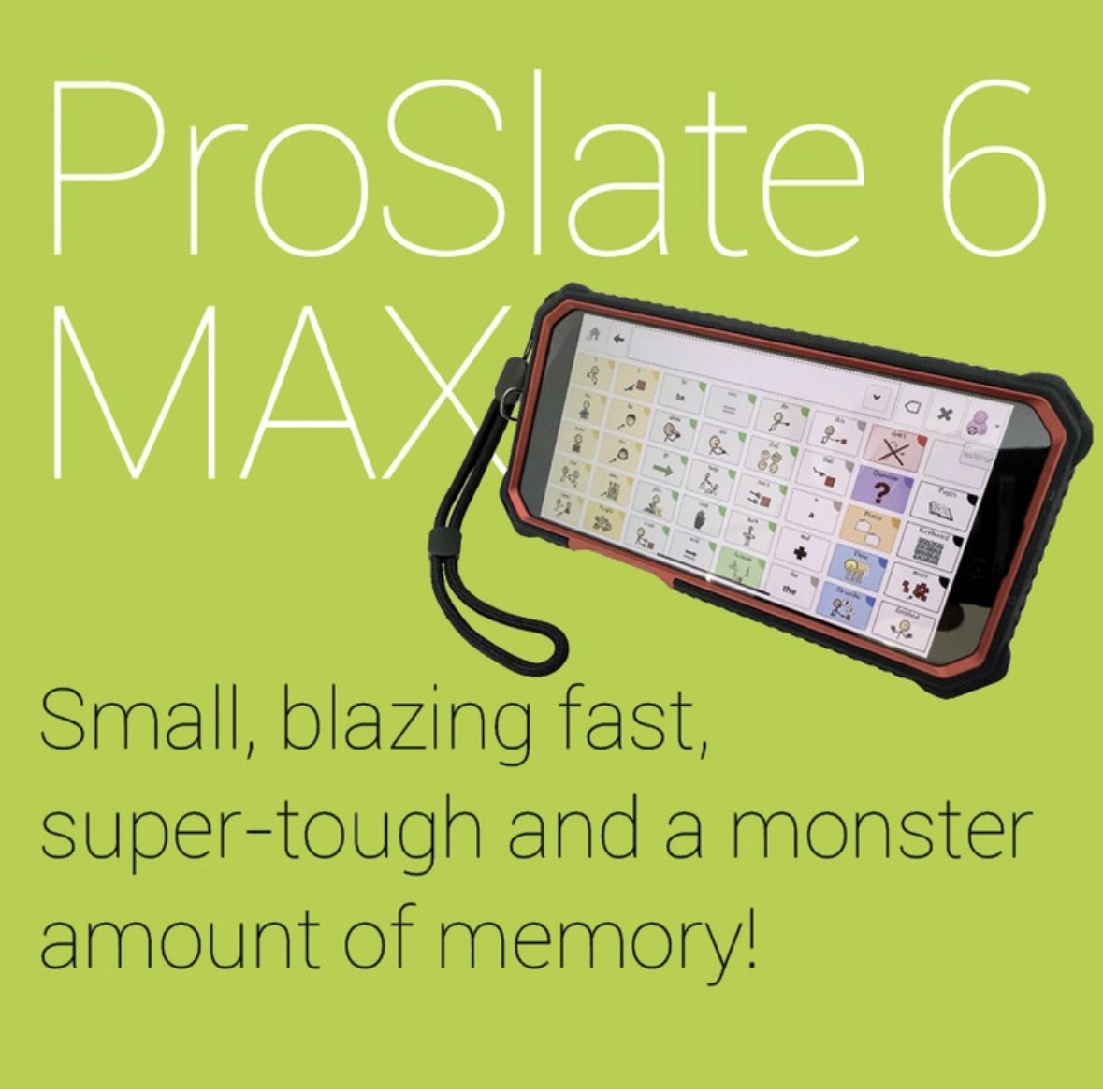 Update 6/6/25: The ProSlate 6D™ MAX is available: https://www.forbesaac.com/proslate-6d-max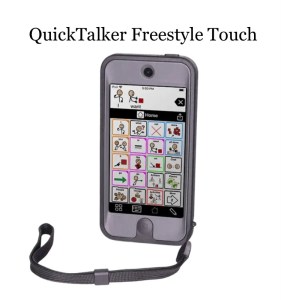












 OMazing Kids AAC Consulting